
The AI Spending Psychosis: Why Bigger Budgets Don’t Mean Better Outcomes
Tech executives are rewarding the size of their AI budgets rather than the quality of outcomes. Here is how to build an AI governance framework that measures what matters.
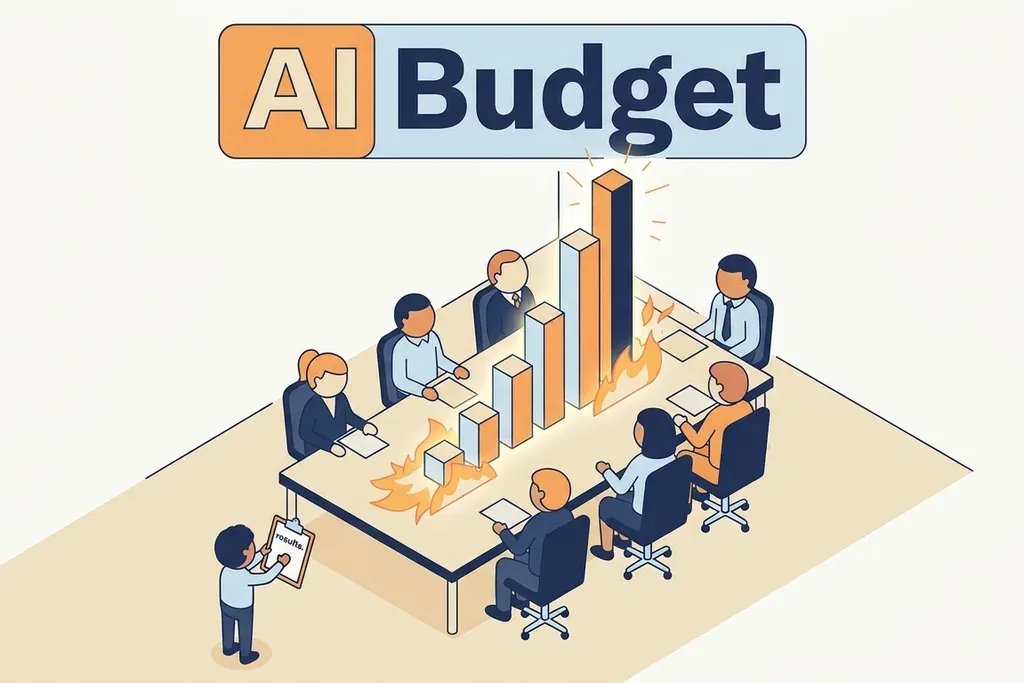
In a candid social media post that has resonated across the industry, one engineer captured what many are thinking: the tech sector is in a state of “mass psychosis” over AI spending. The observation is sharpened by specific examples: Uber burning twelve months of budget in four months, Meta using scoreboards to track token usage, Amazon instructing workers to “token max” on simple tasks, Microsoft removing Claude access and forcing Copilot adoption, and Nvidia’s token bill exceeding its employee payroll.
The pattern is clear, and troubling. Tech executives are competing on the size of their AI bills rather than the quality of outcomes. They are simultaneously cutting loose the talented engineers who understand every crack of their product, redirecting those savings toward massive token consumption. This is a strategic misstep with serious consequences.
The Optics Trap: Spending as a Signal of Competence
When every board, analyst, and investor asks “What is your AI strategy?” the easiest answer is a large number. A seven-figure AI budget signals that leadership is taking the technology seriously. But it signals something else too: that the organization has not yet figured out how to measure the value of its AI investments.
This dynamic mirrors earlier technology bubbles. During the cloud migration wave, companies spent lavishly on AWS credits they never fully utilized. During the big data era, Hadoop clusters ran idle while dashboards collected dust. The AI token spending binge follows the same script. Visible spending as a proxy for strategic intent, disconnected from measurable business outcomes.
Why Token-Based Metrics Are Dangerous
Using token consumption as a performance metric is like rewarding a marketing team for the number of emails sent rather than the revenue generated. It encourages the wrong behavior. When teams are measured on token usage, they optimize for volume. Generating more tokens, whether or not they produce better results.
Meta’s reported use of “scoreboards for token usage” is a textbook example. Scoreboards drive competition, and competition drives volume. But in AI, more tokens do not correlate with better outcomes. A single well-crafted prompt with a small context window can outperform a sprawling multi-shot pipeline that burns thousands of tokens. The metric should be output quality and business impact, not consumption volume.
The Talent Paradox: Cutting Engineers, Buying Tokens
Perhaps the most worrying trend is the simultaneous reduction in engineering headcount and increase in AI spending. Microsoft’s reported removal of Claude access in favor of forced Copilot usage is emblematic. Rather than letting engineers choose the best tool for each task, and trusting their judgment. Leadership mandates a single, often more expensive, solution.
This creates a perverse incentive: the engineers who leave are the ones who know the product best, and the remaining budget is consumed by a tool that may not be the most effective for the job. The talent that built the moat is replaced by a vendor lock-in that is measured in tokens, not in outcomes.
Nvidia’s Uncomfortable Position
The observation that Nvidia’s token bill exceeds its employee payroll is a useful canary. It suggests that even the company manufacturing the hardware is consuming tokens at rates that outpace its human capital investment. If Nvidia cannot model sustainable AI usage internally, what hope do its customers have?
This is not about criticizing Nvidia, it is about recognizing that the entire industry lacks mature governance frameworks for AI spending. When the vendor’s own internal usage is unconstrained, the market signal it sends is that unlimited token consumption is normal. It is not. It is the absence of discipline.
Building an AI Governance Framework That Works
For enterprise decision-makers, the path forward requires a fundamental shift in how AI investments are evaluated. Here are the principles that distinguish strategic AI adoption from the spending psychosis:
- Measure outcomes, not inputs. Token consumption is an input metric. Cost per transaction, accuracy improvements, and revenue attribution are outcome metrics. Build your dashboards around the latter.
- Audit for vendor lock-in. Every AI tool should justify its place in the stack independently. If removing a tool would require re-engineering everything, that is a risk, not an asset.
- Preserve engineering autonomy. Trust your engineers to choose the right tool. Mandated platform decisions should be the exception, not the rule, and should come with transparent cost-benefit analysis.
- Benchmark against alternatives. Before scaling any AI deployment, compare it against a non-AI or simpler-AI alternative. Many problems are better solved with a database query or a rules-based system than with a large language model.
- Cap token consumption by use case. Set hard limits on token budgets per team or workflow. If a use case cannot stay within its budget, it either needs optimization or it is not the right application of AI.
The Bottom Line for Boards and Leadership
The AI spending psychosis will not correct itself. Market dynamics alone, competitive pressure, investor expectations, fear of missing out, push in the opposite direction. It falls to leadership to impose the discipline that the market will not.
Organizations that treat AI spending as a strategic investment, measured by its contribution to business outcomes, will emerge ahead. Those that treat it as a signaling exercise, rewarding the size of the bill rather than the quality of the result. Will find themselves with empty pipelines and burned budgets.
The question every board should be asking is not “How much are we spending on AI?” but “What are we getting for it?” Until that shift happens, the psychosis continues.