
Anthropic’s Claude Science and the Enterprise Audit Trail
Anthropic just shipped Claude Science, an agentic research workbench with a built-in reviewer agent and local-infrastructure option. For regulated industries, the reproducibility and data residency story is the procurement signal that has been missing for two years. A four-step rollout for regulated functions.
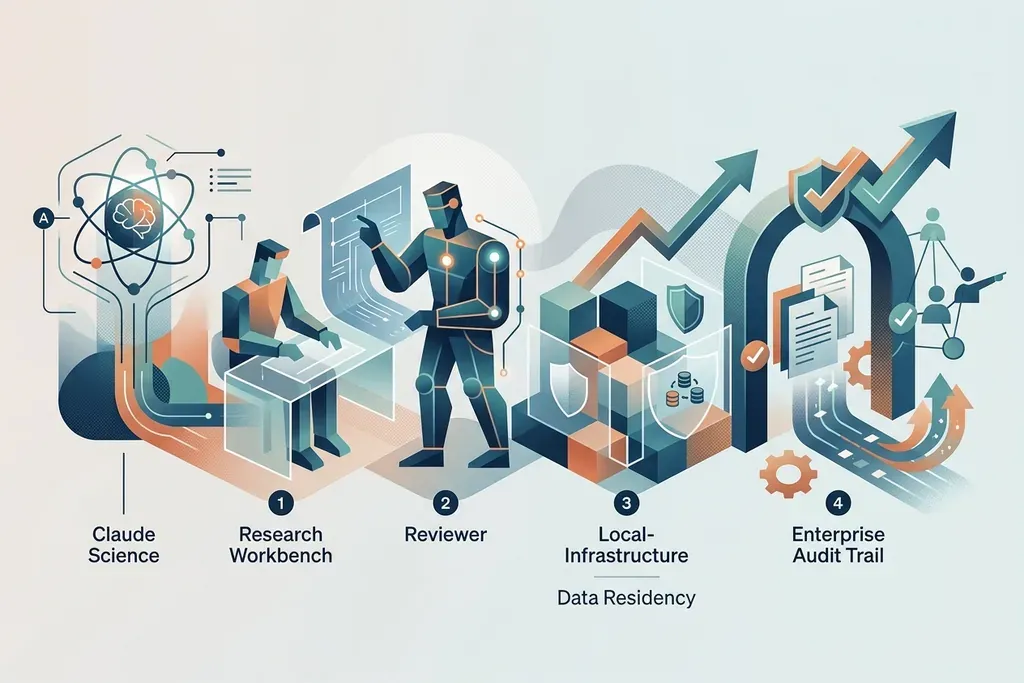
Anthropic just put a research lab on a single screen
Anthropic shipped Claude Science this week, in beta. The framing matters more than the model. Claude Science is not a new foundation model — it runs the same Claude family, including Opus 4.8 — and it is not a chat interface with extra steps. It is an agentic workbench where a coordinating agent plans an analysis, drives the queries, runs the computation, and writes the figure. A separate reviewer agent checks the citations and the math before any result reaches a human. Every chart ships with the code that produced it, the environment it ran in, and a plain-language record of how the answer was built.
For most of the last two years, the conversation inside enterprise AI programs has been about model selection. Which model is best at which task, what the benchmark deltas mean, and how to right-size spend across providers. Claude Science is the moment that conversation starts to move. The interesting question is no longer which model writes the best summary. It is what happens when the whole research workflow (the data pull, the cleaning, the model call, the figure, the audit trail) collapses into one auditable surface.
Why the reproducibility story matters to enterprise governance
The single most under-appreciated line in Anthropic's announcement is also the most boring one: every figure ships with the code that made it, the environment it ran in, and a plain-language record of how it was built. Reproducible months later, by anyone on the team.
That sentence is the answer to the question chief risk officers have been asking AI steering committees since 2023. When a regulated function (internal audit, model risk management, compliance analytics, fraud forensics) runs an analysis on top of a model, the institution has to be able to defend the answer months later. Not the conclusion, the chain of custody. Which dataset, which version, which prompt, which tool calls, which environment. Most AI pilots fail that test the first time a regulator asks. The model output looks fine. The provenance is somewhere in a Slack thread.
Claude Science makes the provenance the default output, not an after-the-fact add-on. The reviewer agent sits between the analysis and the human reader, and it flags anything it cannot trace. For enterprise buyers in financial services, healthcare, life sciences, and legal, that is not a productivity feature. It is the gating item on the procurement checklist.
What the local-infrastructure option actually changes
The second line that enterprise buyers should read twice: the whole thing runs on local infrastructure so sensitive datasets never leave the building, and compute scales from one GPU to hundreds on a lab's own HPC cluster or Modal.
Data residency has been the single biggest blocker to AI deployment in regulated industries. A chief data officer in a European bank does not get to push a portfolio-level analysis through a hosted model without a Data Processing Agreement, a Transfer Impact Assessment, and a long conversation with the supervisory authority. A US health system faces the same wall with PHI. The workaround, until now, has been de-identification pipelines that strip identifiers before the model call and re-identification tables that stay on prem. That works for some use cases and fails badly for others; anywhere the model needs the join between the identifier and the record, de-identification breaks the analysis.
Local execution closes the residency gap without forcing a de-identification compromise. The coordinating agent and the reviewer agent run inside the institution's own perimeter, against the institution's own data, with the same audit trail the cloud version ships. The pricing changes, the data flow does not. For programs that have been stuck at the de-identification step for two years, that is the green light they have been waiting for.
The agentic workbench pattern, read across the enterprise stack
Claude Science is one instance of a pattern that is starting to repeat across enterprise software. Take a function that has historically required a human to glue together five or six tools (data warehouse, notebook, compute cluster, version control, presentation layer) and replace the glue with a coordinating agent that knows how to drive each tool, plus a reviewer agent that checks the result before it surfaces. The pattern shows up in code review, in customer support triage, in competitive intelligence, and now in scientific research.
For enterprise AI programs, the question is not whether to buy Claude Science specifically. The question is which other internal functions are built from the same five-or-six-tools-glued-by-a-human shape, and how quickly the same pattern can be applied to them with the institution's own data and its own review logic. The vendor question is downstream of the workflow question, and the workflow question is the one that actually changes headcount and cycle time.
A four-step path for bringing an agentic workbench into a regulated function
1. Start with the audit trail, not the productivity gain. The first deployment should be against a workflow that has a known answer (quarterly model validation, a recurring compliance check, an internal audit sample). The point is to show the chain of custody works end to end inside the institution's own perimeter. Productivity is a side effect; defensibility is the deliverable.
2. Map the data residency boundary before the model call. For every dataset the agent will touch, decide in advance whether it leaves the perimeter, and document the decision. Cloud-hosted models on de-identified data are fine for some uses. Local execution is required for others. The answer is per workflow, not per vendor.
3. Keep the reviewer in the loop, even when the model is confident. The reviewer agent is the difference between a tool the institution can defend and a tool the institution has to defend alone. Configure it conservatively on the first deployments; flag more than it needs to, surface low-confidence steps to a human reviewer, treat its output as draft, not verdict.
4. Treat the workbench as a procurement unit, not a model choice. The right comparison is between today's manual workflow and the workbench-equipped workflow, end to end. Cycle time, headcount per analysis, audit hours per quarter, and the cost of an error all change at the same time. Model selection is a line item inside that comparison, not the comparison itself.
Where this lands in the 2026 enterprise AI roadmap
The Claude Science launch lands at a specific moment in the enterprise AI cycle. The first wave (2023 and 2024) was about getting a model into production at all. The second wave (2025) was about the unglamorous plumbing: identity, logging, prompt libraries, evaluation harnesses, the back-office work that turns a demo into a system. The third wave, which Claude Science is part of, is about collapsing the manual glue between tools into a single auditable surface, with the data staying where the regulator can see it.
For an AI program that has a working model deployment and a working evaluation pipeline, the next decision is which internal functions are ready for the workbench pattern, and which have to wait for the data residency and review logic to mature first. That is a different question from the one most enterprise AI committees were answering twelve months ago, and it is the one that will define which programs ship measurable ROI in 2026.
Book a strategy consultation to map the agentic-workbench pattern against your regulated workflows.