
Why Most Legal AI Is Just a PDF Summarizer, and What Comes Next
Most legal AI is a GPT wrapper that summarizes PDFs. Ivo Benchmarks scores clauses against a company's own contract history, an institutional memory approach with broader implications for regulated AI deployments.
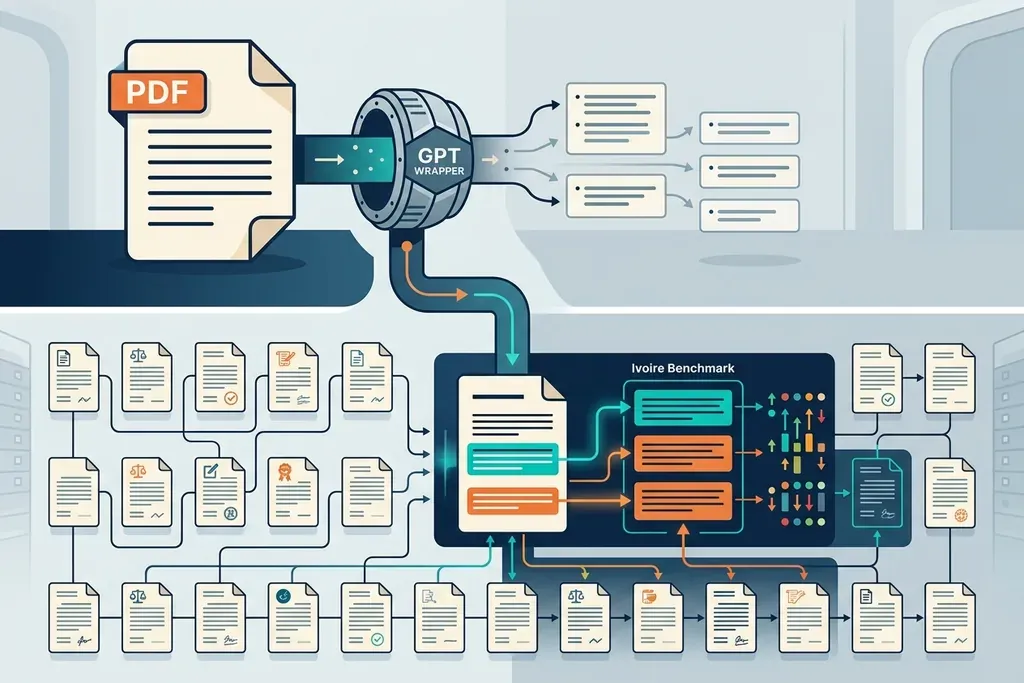
The legal AI market is full of PDF summarizers. Here is what one company built instead.
A pattern has been bothering us for the past eighteen months. Every week, a new "legal AI" tool lands in our inbox, and every one of them does roughly the same thing: a thin wrapper around a general-purpose language model, prompted to read a contract and tell you what it says. Some of them are quite good at that one thing. None of them have anything to do with how lawyers actually negotiate.
Ivo, a legal technology company, just shipped something with a different shape. They call it Benchmarks. The premise is simple and the implications are not: instead of asking a generic model what a clause means, Benchmarks reads the clause sitting in front of you and asks how your own company has handled similar language in past negotiations. It then tells you whether to hold the line or let it go.
That distinction matters, and it is worth understanding why before deciding whether this category of tool belongs on your legal operations roadmap.
Why "summarize the PDF" was never the right product
The summarizer framing was always convenient for vendors and uncomfortable for buyers. Convenient, because a chat-style interface is the easiest thing in the world to demo: paste in a contract, watch the highlights appear, look impressed. Uncomfortable, because the moment you try to use it in production, you hit the wall that real legal teams have always known about.
The wall is that summarizing a document is not the same problem as improving a negotiation. A senior contracts lawyer does not need help understanding what an indemnification clause says. She already knows. What she needs is a view into how her company has priced similar risk across the last three hundred deals, whether the indemnity ceiling on the table is consistent with what her sales counterpart in Munich settled on last quarter, and whether the carve-out language her procurement team has been quietly winning for two years is at risk in this draft.
A language model trained on the public internet has no opinion on any of that. It knows what indemnification clauses look like in aggregate. It has no idea what your indemnification clauses look like specifically, or how you have historically traded them. Summarization is a useful input. It is not a strategy.
Institutional memory is the actual product
What Ivo built, and what the legal AI category has generally avoided building, is a feedback loop. Their customers include companies with millions of executed contracts in their data rooms and no systematic way to learn from any of them. The data exists. The institutional memory to translate that data into negotiating position does not.
Benchmarks works by sitting on top of that contract corpus. When a reviewer encounters a clause in a new agreement, the system looks across the company's own history for similar clauses, similar counterparties, similar deal contexts, and similar outcomes. It then produces a structured recommendation: this language is consistent with what you have accepted before, this language is materially worse than your norm, and this is the specific concession you have historically extracted when faced with this provision.
That is a different category of product. It is not an oracle about what the contract means. It is an oracle about what your company has decided such contracts should mean, drawn from the actual decisions your team has made.
The pattern is bigger than legal
We spend a lot of time with enterprise teams who are trying to figure out where AI will actually move the needle in their business, as opposed to where it will simply generate more text faster. The pattern we keep seeing is that the second question gets most of the attention, and the first question is what separates a meaningful deployment from a demo.
Legal is a useful example because the underlying problem is unusually legible. A large enterprise already has, somewhere in its systems of record, a high-fidelity signal about its own negotiation history. That signal is just sitting there, unstructured, ignored. The interesting move is to instrument it.
Other regulated domains are not far behind. Compliance teams have audit trails that no human reads. Healthcare systems have years of prior authorization decisions that encode real institutional knowledge about what gets approved and why. Financial services firms have exception histories that capture exactly how their risk teams have drawn lines on ambiguous cases. The same architecture that lets Benchmarks surface a company's own negotiation posture out of its contract corpus will, in time, do the same for those domains.
The bottleneck is not the language model. The bottleneck is whether the company has the appetite to build the data plumbing, the change management, and the governance around giving an AI system a structured view of its own institutional history. That is a harder problem than prompt engineering, and it is the only problem worth solving.
What to look for when a regulated-industry AI vendor comes calling
If you are evaluating legal AI, healthcare AI, compliance AI, or any of the regulated-industry AI categories that are filling up your vendor pipeline, the questions worth asking are mostly about the vendor's data model, not its model.
First, ask where the institutional knowledge comes from. If the answer is "we fine-tune on public contracts" or "we use a general-purpose model with a legal prompt," you are talking to a summarizer with a marketing budget. If the answer is "we sit on top of your own corpus and structure it for retrieval," you are talking to something closer to what Ivo built.
Second, ask how the system gets evaluated. A summarizer can be demoed against a public clause and look impressive. A benchmarking system needs to be evaluated against your own historical outcomes: did the recommendation match what your senior reviewer would have done? Did the deal close at terms consistent with the system's guidance? Did the feedback loop actually compound over time?
Third, ask about the change management. The hardest part of any of these deployments is not the model. It is the lawyers, doctors, or compliance officers who have to trust the system's output enough to act on it under deadline pressure. Vendors who have an honest answer to that question are rare and worth their price.
The bigger signal
Ivo's launch is worth paying attention to, but the more interesting observation is what it represents. The category of "wrapper around a general model" is reaching its natural saturation point. The next wave of meaningful enterprise AI will be built by companies who have decided that the institutional memory inside the customer's own data is the actual product, and that the language model is just the rendering layer on top of it.
That is a harder business to build. The data plumbing is unglamorous. The change management is slow. The sales cycle is long. The gross margin on a benchmarking system is structurally lower than the gross margin on a summarizer, because you are doing real work with the corpus rather than handing the customer a chat interface and letting them figure it out.
It is also, in our experience, the only kind of enterprise AI that survives contact with a procurement review.
If your team is mapping out where AI will actually move the needle in your regulated operations over the next twelve months, this is the kind of deployment worth piloting. The summary vendors will keep arriving in your inbox. The benchmarking vendors are the ones building the future of the category.
Book a strategy consultation with our team if you want help mapping where institutional-memory AI fits in your own operating model.