
Rational AI Investment: Navigating the Enterprise Spending Spiral
The AI industry is caught in a spending spiral where budget burn rates have replaced business metrics as the measure of commitment. Here is a rational framework for enterprise AI investment. One that starts with outcomes, not optics.
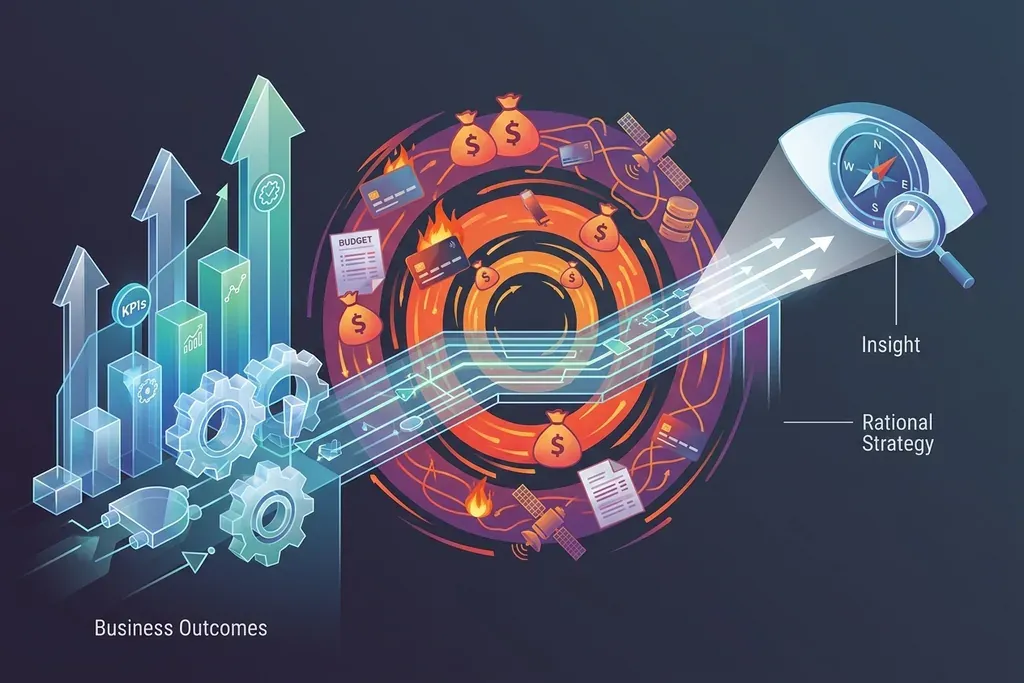
If you have been watching the AI industry closely over the past year, you have probably noticed something unsettling. The spending numbers do not add up. Companies that raised capital for a twelve-month runway are burning through it in four. Internal benchmarks have turned into public scoreboards. And the unspoken rule seems to be: if your competitor is buying GPUs, you had better buy twice as many.
This is not strategy. This is a spiral.
The Psychology Behind the Numbers
When Uber disclosed that it had consumed twelve months of budget in under four months on AI infrastructure, the reaction was not shock. It was a shrug. When Meta installed literal scoreboards tracking GPU allocation across teams, the industry treated it as aspirational rather than cautionary. The pattern is clear: spending has become a proxy for commitment, and commitment has become a proxy for competence.
Enterprise leaders face a real tension here. On one side, the board wants to know why the company is not moving faster on AI. On the other, the CFO is watching the burn rate with increasing alarm. The result is often a compromise that satisfies neither: large, undirected investments that generate activity but not outcomes.
Three Questions to Ask Before the Next Big AI Purchase
The antidote to the spending spiral is not hesitation. It is rigour. Before approving the next major AI line item, we recommend running it through three filters.
First: what specific business metric does this investment move? If the answer is vague, “competitiveness,” “capability,” “future-proofing”, pause. AI investments should trace to a measurable outcome, the same way you would evaluate a new manufacturing line or a CRM deployment. If you cannot name the metric, you cannot name the return.
Second: is the infrastructure sized to the actual workload, or to the anxiety? Many organisations are provisioning for peak hypothetical demand rather than real near-term usage. A large language model fine-tuning run does not require the same footprint as training a foundation model from scratch. Right-sizing early preserves capital for later, when the use case is proven and the demand is real.
Third: are we building internal capability or renting external dependency? The distinction matters. A company that pays a vendor for pre-trained API access is spending differently than one that builds its own fine-tuning pipeline. Both can be valid. The mistake is treating them as interchangeable line items. Know which path you are on and staff accordingly.
What Rational Spending Looks Like in Practice
We work with enterprise teams across manufacturing, logistics, and professional services. The ones moving fastest are not the ones spending the most. They are the ones that started with a narrow, high-value use case, proved it in production, and then scaled.
One client in industrial automation spent three months on a single document classification task before adding anything else. The initial investment was modest, a small fine-tuned model running on existing infrastructure. The return came from reducing manual review time by seventy percent across a high-volume processing pipeline. That success funded the next project. And the next.
This is not slow. It is sequenced. The difference between sequenced spending and reactive spending is the difference between a capital allocation strategy and a panic response.
The Real Risk Is Not Underinvestment
The dominant narrative in AI right now is that companies are moving too slowly. We think the opposite risk is larger and less discussed: organisations are moving fast in the wrong direction, committing resources to projects that have not been connected to business value, and creating sunk-cost dynamics that will be difficult to unwind.
A rational AI investment framework starts with a clear-eyed assessment of what your organisation actually needs, builds from a proven nucleus, and scales only when the evidence supports it. It is less dramatic than the headlines. It is also more durable.
If your team is wrestling with these questions, what to build first, how to size the investment, whether the numbers actually make sense, we would be glad to discuss it. No scoreboards required.