
NVIDIA's Nemotron 3 Ultra: What Open-Source 550B MoE Models Mean for Enterprise AI Strategy
NVIDIA released Nemotron 3 Ultra, a fully open-source 550B-parameter Mixture-of-Experts model with a 1M-token context window and hybrid Mamba-attention architecture. We examine the implications for enterprise AI procurement, inference costs, and deployment in regulated industries.
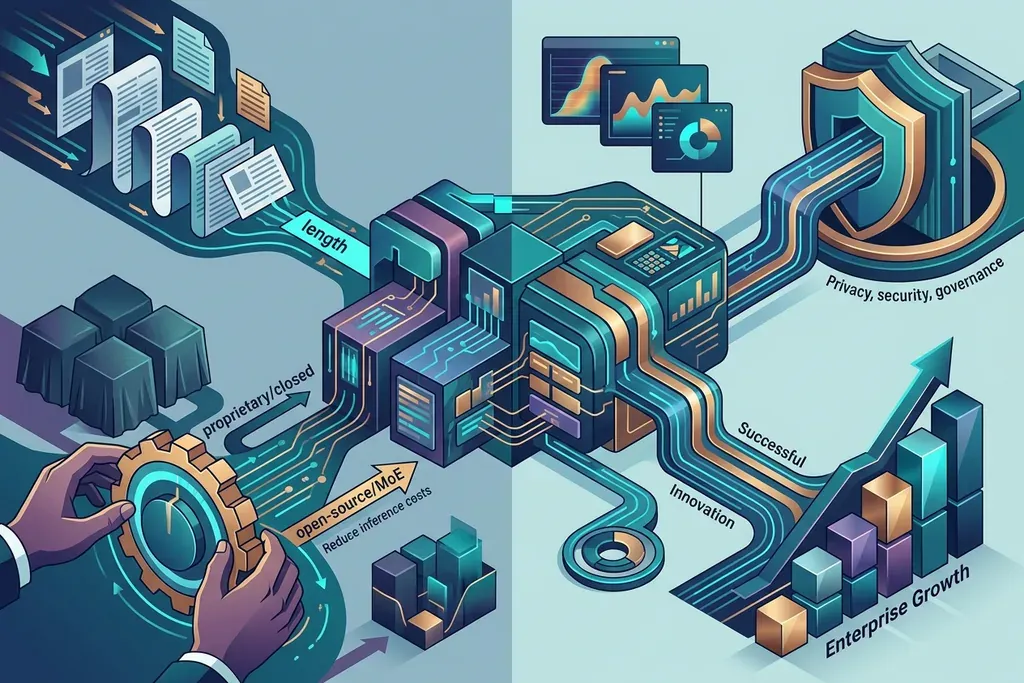
NVIDIA has released Nemotron 3 Ultra, a 550-billion-parameter open-source model that represents a significant shift in the enterprise AI landscape. Built on a Mixture-of-Experts architecture with only 55 billion active parameters per token, the model introduces a hybrid Mamba-attention design and supports a 1-million-token context window. The complete release of weights, training data, and recipe signals a departure from the opaque, API-gated approach that has characterized much of the frontier model ecosystem. For enterprise decision-makers evaluating AI procurement and deployment strategies, this release warrants close attention.
The Architecture: Why the Hybrid Design Matters for Production
Nemotron 3 Ultra employs a Mixture-of-Experts architecture in which only 55 billion of its 550 billion total parameters are activated for any given token. This sparsity means the model delivers capability comparable to much larger dense models while requiring substantially less compute during inference. The efficiency gain is material for organizations running AI workloads at scale: lower per-token cost, reduced latency, and the ability to serve high-quality inference on fewer GPUs.
The architectural innovation extends beyond MoE sparsity. Nemotron 3 Ultra combines Mamba state-space layers with traditional attention mechanisms in a hybrid design. State-space models offer linear-time processing for long sequences, avoiding the quadratic cost of full attention. By alternating Mamba and attention layers, NVIDIA achieves a practical balance: the state-space layers handle the heavy lifting on extended contexts while attention layers preserve the recall and precision that enterprises need for document analysis, code understanding, and compliance review. For organizations processing lengthy documents, legal contracts, or financial reports, this hybrid design directly addresses the cost barrier that has limited production adoption of large-context models.
The 1-Million-Token Context: A New Threshold for Enterprise Applications
A 1-million-token context window places Nemotron 3 Ultra in a category that previously belonged almost exclusively to proprietary models. This capacity allows an enterprise to process entire regulatory filings, complete audit trails, multi-hundred-page contracts, or full codebase snapshots in a single inference pass. For regulated industries such as financial services, healthcare, and legal, the ability to analyze complete documents without chunking and re-embedding reduces both error risk and architectural complexity.
The practical implication is that enterprises can now build document-grounded workflows that do not depend on retrieval-augmented generation pipelines for context that fits within the window. This simplifies system design, reduces the number of failure modes, and lowers the engineering overhead required to maintain RAG infrastructure. For organizations with established AI teams, long-context models enable faster prototyping and simpler production architectures. For those earlier in their AI journey, the reduced architectural complexity lowers the barrier to building reliable, context-aware applications.
Open Weights, Data, and Recipe: Procurement Risk and Vendor Independence
NVIDIA has released not only the model weights but also the training data and the full training recipe. This level of openness has strategic implications for enterprise procurement. When a model's weights are fully available, organizations can self-host inference and fine-tune the model on proprietary data without third-party API dependencies. When the training data is transparent, organizations can audit for bias, contamination, and data quality concerns that matter in regulated settings. When the recipe is public, teams can reproduce, modify, and extend the training process for domain-specific needs.
For enterprise technology officers, this transparency reduces the vendor lock-in risk associated with proprietary models. An open-weight model that can be deployed on private infrastructure or in a virtual private cloud allows organizations to maintain control over data governance, security posture, and cost structure. The ability to exit a commercial API relationship without losing access to the model capability is a meaningful negotiating advantage. Enterprises should consider open-source models like Nemotron 3 Ultra as a credible alternative in AI procurement evaluations, particularly for workloads with strict data residency or compliance requirements.
Implications for Regulated Industries
Financial services, healthcare, and legal sectors face the most stringent requirements around model transparency, data privacy, and auditability. Nemotron 3 Ultra's open release addresses each of these concerns directly. Financial institutions subject to model risk management guidelines such as SR 11-7 can conduct independent validation when the training data and architecture are fully specified. Healthcare organizations handling protected health information can deploy the model on HIPAA-compliant infrastructure without exposing patient data to external API endpoints. Legal teams processing confidential documents can maintain complete control over data flows and retention policies.
The 1-million-token context window is particularly consequential for legal and compliance use cases, where document length routinely exceeds the capacity of standard models. Contract analysis, regulatory filing review, and discovery document processing all benefit from the ability to ingest full documents in a single pass. For regulated enterprises currently evaluating whether to adopt large language models in production, Nemotron 3 Ultra offers a path that does not require surrendering data control to a model provider.
Evaluating Open-Source Versus Proprietary Models in the Current Landscape
Nemotron 3 Ultra enters a market where enterprises face an increasingly complex choice between proprietary frontier models and a growing field of capable open-weight alternatives. Proprietary models from providers such as OpenAI, Anthropic, and Google offer convenience, managed infrastructure, and rapid iteration. Open-source models offer transparency, portability, cost control, and the ability to customize. The gap in capability between the two categories continues to narrow, and Nemotron 3 Ultra's combination of scale, context length, and architectural efficiency makes it one of the strongest open-weight options available.
Enterprise decision-makers should evaluate models along several dimensions: total cost of ownership across inference volume, data governance requirements, integration complexity, and the longevity of the model ecosystem. Open-source models reduce per-token inference costs over time because organizations are not paying per-API-call margins. They also eliminate the risk of sudden API pricing changes, deprecation of model versions, or policy shifts that restrict use cases. The trade-off is that enterprises must invest in the infrastructure and talent to self-host and maintain the model. For organizations at sufficient scale, the arithmetic favors open-weight models.
Strategic Recommendations for Enterprise AI Teams
Organizations should treat Nemotron 3 Ultra as a serious candidate for evaluation, not as a research curiosity. We recommend the following approach for enterprise teams assessing this model for production deployment:
First, benchmark the model against your specific use cases rather than relying on published aggregate metrics. The MoE architecture produces different quality profiles across domains, and your data will reveal whether the model's strengths align with your requirements. Second, evaluate the inference cost breakpoint where self-hosting Nemotron 3 Ultra becomes more economical than API-based alternatives, accounting for hardware acquisition or rental costs. Third, conduct a governance review of the open training data and license terms to ensure alignment with your compliance framework. Fourth, assess whether the 1-million-token context window simplifies or eliminates existing RAG pipelines in your architecture, potentially reducing engineering and operational overhead.
Nemotron 3 Ultra represents a meaningful maturation of the open-source AI ecosystem. For enterprises making strategic decisions about AI adoption and infrastructure, it provides a credible, transparent, and production-relevant option that deserves a place in the evaluation pipeline alongside proprietary offerings.
Source: @rryssf on X (NVIDIA announcement); NVIDIA technical publication on Nemotron 3 Ultra architecture.
Is your organization evaluating open-source models for production AI deployment? Consider how Nemotron 3 Ultra fits into your AI strategy. Book a strategy consultation to discuss your specific requirements and infrastructure needs.